



by Mario Nawfal at X
This page from the newly released files references the infamous Franklin Cover Up, alleging that “children’s homes and government mind control programmes are the major source of children for the American elite.”
It specifically names Boys Town, Nebraska, and claims a “homosexual prostitution inquiry ensnares VIPs with Reagan, Bush.”
The document states the story “almost got out” during the Reagan and Bush administrations but “was quickly covered up after this was published in 1989.”
These allegations have circulated for decades.
Source: DOJ
EPSTEIN FILES: FBI DOCUMENTS REFERENCE “FRANKLIN COVER UP” ALLEGATIONS TYING REAGAN AND BUSH ADMINISTRATIONS TO ABUSE NETWORK
This page from the newly released files references the infamous Franklin Cover Up, alleging that “children’s homes and government mind control… https://t.co/Qfpjh8k2dp pic.twitter.com/UWzFRKMNgL
— Mario Nawfal (@MarioNawfal) January 30, 2026
______________________________________
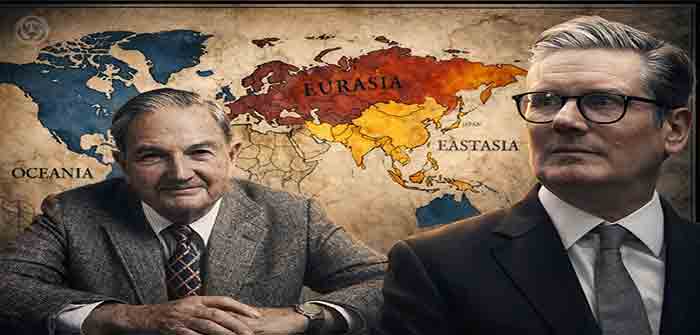
From Rockefeller to Starmer: Mapping the Trilateral Network in the Epstein Files

The Vision
In 1949, George Orwell imagined a world divided into three perpetually warring superstates: Oceania, Eurasia, and Eastasia. Each bloc controlled its population through surveillance, managed information, and the systematic erosion of independent thought. The Party’s slogan was clear: “War is Peace. Freedom is Slavery. Ignorance is Strength.”
In 1973, David Rockefeller founded an organisation that divided the world into three regions: North America, Europe, and Asia-Pacific. Its membership would be drawn from those who control finance, media, academia, and (notably) “a few trade union chiefs.” Its operating philosophy, published two years later, argued that Western societies suffered from “an excess of democracy” and that the solution required “some measure of apathy and non-involvement on the part of some individuals and groups.”
The Trilateral Commission does not call itself an oligarchy. It describes itself as a forum for cooperation, “committed to the pursuit of the European unification process” and “democratic principles.” But its structure tells a different story. Membership is strictly invitation-only. Representatives are allocated by “economic weight and political influence.” Meetings operate under the Chatham House Rule, permitting participants to use information but prohibiting attribution, “thereby enabling candid exchanges among elites without fear of public misquotation or reprisal.”
This is not democracy. This is its replacement.
The vision is elegant in its simplicity: a world organised into three trading blocs, coordinated by those who own capital rather than those who work for wages, governed through institutions sufficiently removed from popular accountability that policy can be made without the inconvenience of consent. Workers are not represented in this system; they are managed. Trade unions are not partners; selected leaders are recruited to ensure compliance. Elections continue, but the range of acceptable outcomes narrows until voting becomes a ritual that changes nothing fundamental.
The European Union, in this framework,…
Continue Reading