
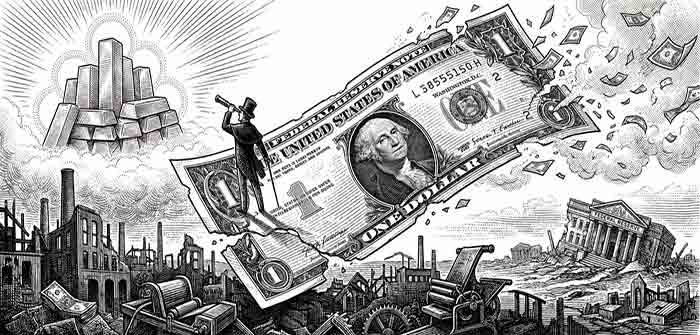



by Peter Girnus at X
My satirical post on “a currency strategist at Treasury” struck a nerve. Hundreds of thousands of impressions. hundreds of comments. The engagement tells me something important: people sense something is wrong with the currency, but they can’t quite articulate what.
This article provides the receipts. Every claim in that satire was based on real policy, real data, and real documents. Here’s the evidence.
The Mar-a-Lago Accord Is Real
In late 2024, Stephen Miran—then an economic advisor, now Chair of the Council of Economic Advisors and Federal Reserve Board member—published a policy paper titled “A User’s Guide to Restructuring the Global Trading System.”
The document, informally called the “Mar-a-Lago Accord” in policy circles, explicitly advocates for strategic U.S. dollar devaluation as official policy.
Miran invokes economist Robert Triffin’s analysis: as the world’s reserve currency, the dollar must run persistent current account deficits. This creates “asymmetric trade conditions” that harm American manufacturing and workers while benefiting trading partners—particularly China.
The solution, per the Accord: weaken the dollar deliberately to make American exports cheaper and imports more expensive.
The architect of this policy now sits on the Federal Reserve Board. He was appointed in September 2025. In December 2025, he dissented from the FOMC decision, advocating for deeper rate cuts. The policy is the person.
The Dollar Has Collapsed
As of January 28, 2026, the U.S. Dollar Index (DXY) stands at approximately 96.15—the lowest level since February 2022.
The index has declined declined approximately 8-11% from 2025 highs. It fell approximately 2% in the past month alone. It has dropped for four consecutive sessions, breaking below its H2 2025 trading range. The dollar breached 1.20 against the euro.
Technical analysts describe this as “building momentum in weakness.” Not a correction but rather a trend.
Gold Is the Exit Sign
Gold has surged past $5,000 per ounce for the first time in history.
Gold gained approximately 17% since the beginning of 2026. It rose 12% in just the first three weeks of January.
Goldman Sachs raised its 2026 target from $4,900 to $5,400 per ounce. Bank of America projects gold could reach $6,000 per ounce by Spring 2026.
The driver is central bank buying. Emerging market central banks are purchasing approximately 60 tonnes of gold per month. China alone accumulated gold for 14 consecutive months through December 2025, reaching 74.15 million ounces.
Not speculation, but rather de-dollarization in action.
The 97% Decline Is Real
Since the Federal Reserve was established in 1913, the U.S. dollar has lost approximately 96-97% of its purchasing power according to the Federal Reserve’s own Consumer Price Index data.
One dollar in 1913 equals approximately three to four cents today. Cumulative inflation since 1971 exceeds 700%. The annual compound rate is approximately 3.85% per year.
The key inflection point was August 15, 1971, when Nixon ended dollar convertibility to gold. He called it “temporary.” It’s been 55 years.
Before 1971, inflation was constrained by gold reserves. After 1971, the only constraint is political will. There has been none.
Consumer Confidence Has Collapsed
The Conference Board Consumer Confidence Index fell to 84.5 in January 2026—the lowest level since May 2014 and below COVID-19 pandemic lows.
The overall index dropped 9.7 points from December. The Present Situation Index fell 9.9 points to 113.7. The Expectations Index tumbled 9.5 points to 65.1.
The Expectations Index at 65.1 is below the 80 threshold that typically signals recession risk.
According to Conference Board Chief Economist Dana M. Peterson, elevated concerns include inflation (especially gas and groceries), tariffs and trade policy, politics, the labor market, health insurance, and war.
People feel something is broken. The data confirms it.
The Debt Cannot Be Repaid
The U.S. national debt currently stands at approximately 100% of GDP.
The Congressional Budget Office baseline projects debt reaching approximately 120% of GDP by 2035. The Committee for a Responsible Federal Budget’s adjusted baseline—which incorporates recent legislation and elevated Treasury yields—projects 134% of GDP by 2035.
By fiscal year 2035, CRFB projects federal spending at $10.9 trillion, federal receipts at $7.4 trillion, a fiscal deficit of $3.5 trillion (nearly 8% of GDP), total debt of approximately $59 trillion, and net interest costs exceeding $2.5 trillion annually.
You don’t pay down 134% debt-to-GDP. You inflate it away. You devalue the currency it’s denominated in. Not default, but rather policy.
The Fed Is Losing Independence
The December 2025 FOMC minutes reveal Stephen Miran—the architect of the Mar-a-Lago Accord—dissenting in favor of a deeper rate cut: 50 basis points versus the committee’s 25.
A survey of economists found that 89% believe if the Federal Reserve loses independence, risk premiums will rise, Treasury yields will spike, and borrowing costs will explode.
The administration doesn’t call it taking independence. They call it “rethinking coordination.” Same outcome. Different press release.
What This Means For You
If you hold dollars, your purchasing power is declining by design.
According to the Mar-a-Lago Accord framework, a weaker dollar makes American exports competitive. But import costs rise—that’s your groceries, electronics, and gas. Your savings buy less each year. Asset prices rise. If you own things, you win. If you earn things, you lose.
Central banks aren’t buying Treasuries. They’re buying gold.
China reduced Treasury holdings by $95.5 billion in eight months while accumulating gold for 14 consecutive months.
Sweden and Denmark’s pension funds are diversifying away from dollar assets.
They’ve read the policy. They’re protecting themselves.
Conclusion
The dollar isn’t failing. It’s succeeding—at exactly what it was designed to do.
The Mar-a-Lago Accord isn’t a conspiracy theory. It’s a published policy paper written by someone who now sits on the Federal Reserve Board.
Dollar devaluation isn’t accidental. It’s strategic.
The 97% decline since 1913 isn’t a bug. It’s a feature.
The only question is whether you’ll act on this information or experience its consequences.
Central banks are buying gold. The question is: what are you buying?
Sources
Federal Reserve Economic Data (FRED) – Dollar purchasing power, CPI data
Trading Economics – DXY index levels, currency data
The Conference Board – Consumer Confidence Index, January 2026
Committee for a Responsible Federal Budget – Debt projections, fiscal analysis
Congressional Budget Office – Baseline budget projections
Goldman Sachs Research – Gold price targets
Bank of America – Gold price forecasts
Kitco News – Precious metals analysis
Finance Magnates – Gold market analysis
Economic Times India – Central bank Treasury holdings
Council on Foreign Relations – Mar-a-Lago Accord analysis
El País – “Sell America” trade analysis
Global Policy Journal – Miran policy analysis
Federal Reserve FOMC Minutes – December 2025
MarketPulse – DXY technical analysis
Action Forex – Currency market analysis
This article is for informational purposes only and does not constitute financial advice. Always consult a qualified financial advisor before making investment decisions.
Here is the link to Girnus’s ‘Satarical’ post mentioned at the beginning of the article
Continue Reading